
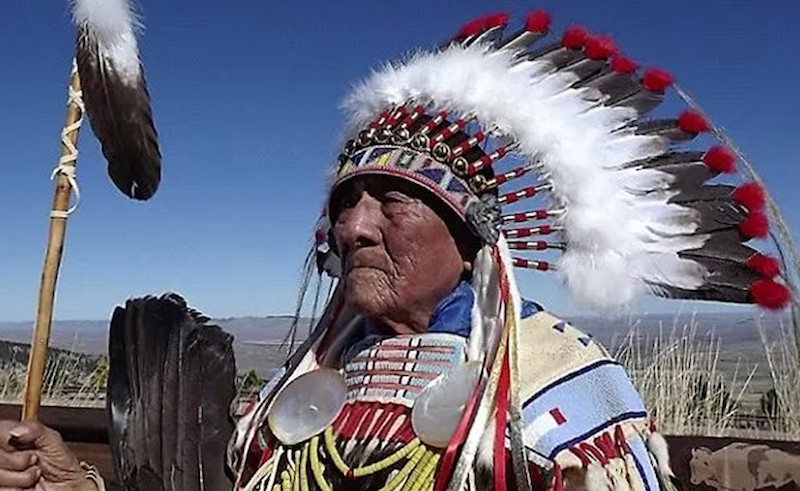
1913-2016 2016 Montana Cowboy Hall of Fame Inductee
High Bird – Dr. Joseph “Joe” Medicine Crow was born near Lodge Grass, Montana on October 27, 1913. At age eleven he was present for and heard interviews conducted with his step-grandfather, who was an eye witness at the Battle of the Little Big Horn. White Man Runs Him, his step-grandfather was a scout for General George Armstrong Custer. Medicine Crow personally knew four of the scouts that had been with Custer near the Little Big Horn River that day in 1876.
In 1939, he earned a Master’s in Anthropology specializing in the effect of European culture on Native Americans from the University of Southern California and was the first member of the Crow tribe to earn a Master’s Degree. He began his doctorate studies and by 1941 had completed the coursework. He began writing his dissertation but did not complete his doctorate because as he explained his uncle, named “Uncle Sam” had other plans for him.
During WWII, Medicine Crow completed the four tasks to become a war chief, the last member of the Crow tribe to do so. He touched an enemy without killing him (1) and disarmed him (2) when he turned a corner and ran into a German soldier. He led a successful war party (3) and stole fifty horses (4) from a battalion of German SS officers.
As the tribal historian, he was a frequent guest speaker at Little Big Horn College and the Battlefield Museum. He wrote the script that has been used in the Battle of the Little Big Horn reenactment held every summer in Hardin since 1965. He preserved the stories and photographs of his people in an archive he kept in his home.
On June 25, 2008, Medicine Crow received two military decorations: The Bronze Star for his service in the United States Army and the French Legion of Honor Chevalier medal. On August 12, 2009, he was awarded the Presidential Medal of Freedom by President Barack Obama.
Joseph Medicine Crow continued to write and lecture at universities and public institutions until his death at the age of 102 on April 3, 2016 in Billings, Montana. During his remarkable life, Medicine Crow was a respected and accomplished writer, author, historian, anthropologist, warrior, educator, and sought-after speaker. He appears in the books and scripts of documentaries about the Little Big Horn and his service in World War II. On the day of Medicine Crow’s death Senator Jon Tester said “Today Montana lost a treasure. Joe Medicine Crow was a soldier and a scholar, but above all he was a fierce advocate for Native American Families.”