
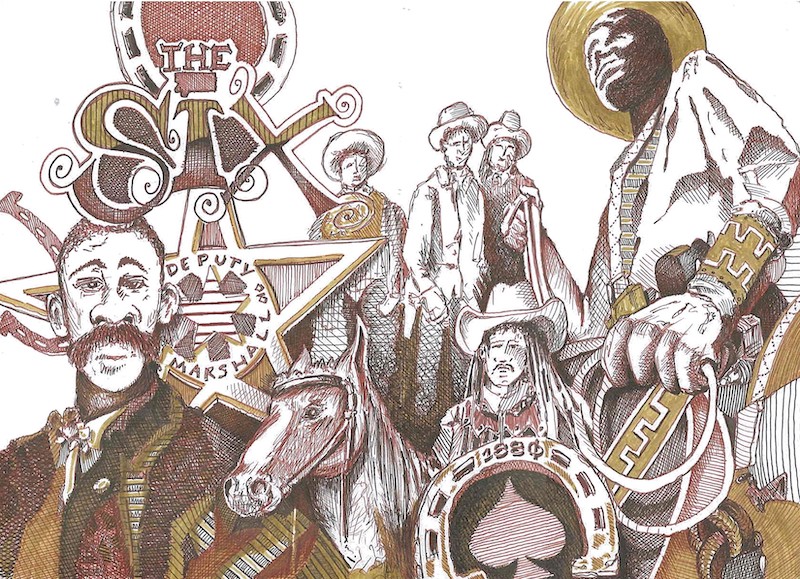
Black cowboys formed the backbone of the 19th-century cattle industry, making up roughly one in four cowhands on the open range. Many African American fur traders and ranch hands worked the ranches and stage lines in the Montana Territory, holding essential roles as wranglers, trail cooks, and herders.
Enslaved people and freedmen used inherited West African livestock skills and knowledge to drive herds, yet they were actively erased by Hollywood Westerns and Jim Crow-era segregation. Former slaves and freedmen sought a life where their skills were highly valued. On the untamed frontier, race mattered less than a person’s ability to ride, rope, and survive the elements.
When most people think of cowboys, they rarely envision the rich, vibrant history of African American ranchers and riders who were instrumental in shaping the American West. Larry Callies, founder and operator of the Black Cowboy Museum in Rosenberg, Texas, is changing that narrative by preserving a powerful story of heritage, skill, and resilience largely overlooked in traditional Western histories. Pop culture mythicized Western culture beginning with the 1945 film Lone Texas Ranger followed by the television series The Lone Ranger in 1949-1957, which depicted the Lone Ranger as a white cowboy with a black mask when
the real Lone Ranger and frontier hero was a black man. Today the black cowboy has risen in profile, embodied by the legendary Bass Reeves, who figures prominently in the hit HBO series Watchmen.
Callies grew up working cattle and riding horses across Texas, but originally pursued a career as a country musician. After losing his singing voice in 1990 due to a neurological condition, he shifted his focus, stepping “out in faith” to open the museum in 2017.
He has spent decades collecting rare artifacts to educate the public about the true origins of the cowboy. The museum is all laid out over two rooms: the first focused on early day black cowboys,
the second on black rodeo. Since its inception, the museum has attracted thousands of inquisitive visitors from across the nation. It has been featured in the New York Times and on season one of the Netflix documentary High on the Hog: How African American Cuisine Transformed America, an episode entitled Freedom.
Bill Pickett: The Dusky Demon Bull-Dogger
By Hope Good
Willie M. “Bill” Pickett was an African American cowboy and renowned rodeo performer who invented the “bulldogging” technique (steer wrestling), which remains a staple in rodeo events today.
Pickett was born in the Jenks Branch community of Williamson County, Texas, in 1870. He was the second of thirteen children born to Thomas Jefferson Pickett, a former enslaved man, and Mary “Janie” Gilbert. The family’s ancestry was African-American and Cherokee.
After fifth grade he left school to become a ranch hand and soon began to ride horses and watch the Texas Longhorn steers of his native Texas. While working he invented the technique of bulldogging. It was known among cattlemen that, with the help of a trained bulldog, a stray steer could be caught. Pickett practiced his stunt by riding hard, springing from his horse, and wrestling the steer to the ground. His method for bulldogging was biting a cow on the lip and then falling backward.
Pickett soon became known for his tricks and stunts at local country fairs. With his four brothers, he established The Pickett Brothers Bronco Busters and Rough Riders Association where he mastered his bulldogging act. The name Bill Pickett soon became synonymous with successful rodeos.
In 1905, he joined the 101 Ranch Wild West Show that featured the likes of Buffalo Bill, Will Rogers, Tom Mix, and Lucille Mulhall; performing under the name “The Dusky Demon,” traveling across the United States, Canada, Mexico, South America, and England, outshining other famous acts of his era.
Because of segregation and racism, Pickett was barred from competing in many standard rodeos. To perform, he frequently had to pass as “Mexican” or Comanche. Pickett challenged racial barriers to become the first Black cowboy movie star, headlining silent pictures produced by Richard E. Norman Studios, including The Crimson Skull (1921) and The Bull-Dogger (1922).
His pioneering achievements have been widely recognized with inductions, being enshrined into the National Cowboy & Western Heritage Museum’s Rodeo Hall of Fame in 1971 and the ProRodeo Hall of Fame in 1989.
Founded in 1984 by concert promoter Lu Vason, the Bill Pickett Invitational Rodeo remains the longest-running touring African American rodeo, celebrating black cowboy culture across the country.
The U.S. Postal Service issued a legend series stamp in his honor in 1994 (though early printings accidentally featured his brother, making it a rare collector’s item).
The Red, White, and Black Rodeo
By Catharine Melin-Moser
While little is known about cowboy George Fletcher’s youth, one story tells of the day he spotted an Indian on horseback chasing a mustang across the wide-open range. The Indian threw a rope over the horse, threw it to the ground, vaulted onto its back, and as Fletcher watched, spellbound, the bucking mustang and Indian disappeared into the horizon. After witnessing that spectacle, Fletcher too, wanted to ride wild horses.
At the Pendleton Round-Up in Pendleton, Oregon, on September 14, 1911, broncos bucked during the Saddle Bronc Championship of the Northwest. Three judges scored the competition down to three cowboys of three different races: George Fletcher was Black; Jackson Sundown was Nez Perce; and John Spain was White. Coverage by the Oregonian put this spin on the event: “the competition would resolve itself into a racial struggle, with a member of the red, white and black races to fight for supremacy.”
Jackson Sundown’s long black braids whipped the air as his mount, Lightfoot, side-winded into a mounted judge during the final the go-round. At the smacking of two saddles, Sundown
lost a stirrup and flew skyward before slamming into the ground. Fortunately, the only injury the dazed cowboy sustained was a blow to his pride.
John Spain on Long Tom was next out of the chute. Long Tom plunged and pirouetted right into the arena fence. Spain hung on for what seemed a dandy ride, but cowboys close to the action said that Spain’s free hand had touched the saddle when Long Tom hit the fence. A touch would warrant disqualification. If Spain’s hand had, indeed, touched the saddle, the judges missed or overlooked it.
George Fletcher and Del were the next pair loosed in the arena, but in no mood for a wild ride, Del refused to buck. A judge called out, “Re-ride!” Sweeney was Fletcher’s new mount. The chute opened and Sweeney leaped skyward and jerked sideways, but Fletcher rode in perfect rhythm with the rise, fall, and twist.
The last go-round had ended. A judge announced: “John Spain, first! George Fletcher, second!” Choruses of “Boo! Boo!” resounding across the grandstand rallied a spirited group of spectators. They lifted Fletcher onto their shoulders and began parading him around the arena. The crowd responded with cheering, “People’s Champion!”
George Fletcher was welcomed back to the Pendleton Round-up many times. He lived long enough to witness his 1969 induction into the Pendleton Round-Up & Happy Canyon Hall of Fame. He died in Pendleton on October 1, 1973. A bronze statue of the cowboy was unveiled on Main Street in 2014.
Nat Love: The West’s Epic Cowboy
By Catharine Melin-Moser
Few tales of legendary cowboys capture the true essence of the Old West as vividly as Nat Love. Nat, (pronounced Nate), was born in June 1854 as a slave on the Robert Love plantation in Davidson County, Tennessee.
After the Civil War was fought and the slaves freed, Nat took jobs at various plantations. At a Tennessee farm, while earning a dime for each colt he broke, he discovered his great skill in breaking horses. By 1869 and in Dodge City, Kansas, Nat could ride most anything with four legs. He approached the trail boss of a Texas outfit, the Duval Ranch, and asked for a job. The boss pointed to a horse. He’d give Nat a job if he could stay on the outfit’s rankest unbroken horse. Nat threw his saddle over the horse named Good Eye. As Nat told it, “I stayed with him, and the cowboys were the most surprised outfit you ever saw as they had taken me for a tenderfoot, pure and simple.” The boss hired Nat at $30 a month, and the Texas cowboys gave Nat the nickname “Red River Dick.”
Nat continued to hone his skills as a hand. This paid off nicely when one outfit promoted him to cattle buyer and chief brand reader. Traveling to Mexico several times, he learned to speak Spanish fluently. In Arizona in 1872, Nat claimed to have found himself in harrowing situations such as facing down rustlers, outlaws, and Pima Indians. His biographers, however, speculate. They suggest that Nat’s tales tended toward exaggeration and were likely influenced by Wild West-themed dime novels so wildly popular at the time.
Nat secured his status in American West folklore on July 4, 1876, in Deadwood, South Dakota. The cowboys there marked the Independence Day holiday by holding roping, bridling, saddling and shooting competitions. Nat won every event. He pocketed $200 in prize money and walked away with another nickname “Deadwood Dick.”
His marriage in the late 1880s to Alice Owens signaled the end of his cowboy life. Some reports noted that the couple had one child; others noted “daughters.” Nat transitioned to hotel and railroad porter. He and Alice eventually settled in southern California.
In 1907, Nat published his autobiography, The Life and Adventure of Nat Love, Better Known in the Cattle Country as “Deadwood Dick.” The American public, always eager for tales of Wild West adventure, snapped up copies of his book. Nat and his legacy have since inspired the early American cowboy prototype. He died in Santa Monica, California, on February 11, 1921. He is buried in the Woodlawn Cemetery.