


By Billie J Olson
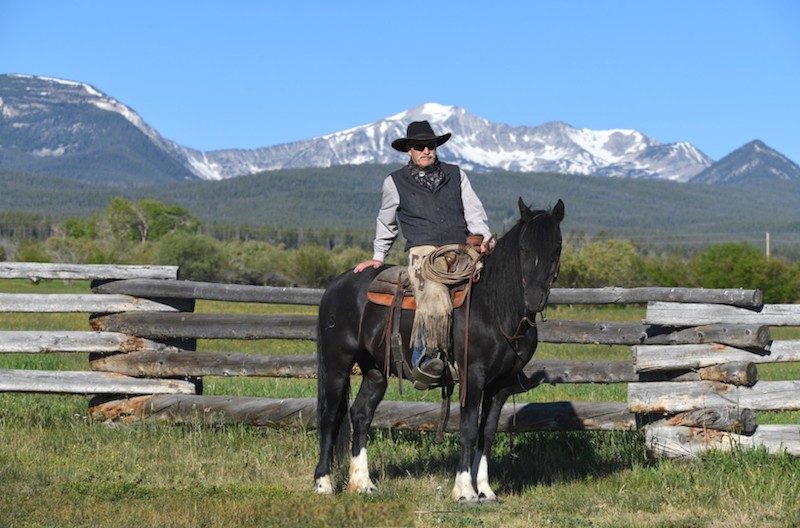
In the high desert of Nevada, 100 miles north of Elko, the morning air is often thick with the dust of a hundred saddle horses being run into a rope corral. For Philip Page, this wasn’t a scene from a movie; it was a Tuesday morning on the YP Ranch. Now 68, Page is taking those fifty years of “horseback life” and turning them into a historically accurate, musical bridge to Montana’s vanishing frontier.
A singer-songwriter and storyteller, Page has been a fixture of the Montana landscape since 1980. Over the decades, he has worked several cow camps and for many different outfits across the state, gaining the firsthand experience necessary to promote and preserve Montana’s authentic history. These days, he is traveling across Montana to perform a multimedia experience that blends original music with the iconic art of Charlie M. Russell and the photography of L.A. Huffman.
Page’s own story mirrors that of the man who inspires much of his music. Like Russell, Page came west as a teenager looking for adventure. Born on a dairy farm in Vermont where his father raised Morgan horses, Page landed in the Frank Church Wilderness in 1976. He spent months at a time with only horses and mules for company, emerging only when the December snows forced him out.
Reflecting on his early years, Page says, “I see kids today hung up on their phones with no direction. I tell them you need to be passionate about something. For me, it was the horse.”
That passion led him to the big cow outfits: the YP, the Wine Cup, and the MC Ranch. It was there, living in range teepees and trailing cattle, that he taught himself guitar and began to find his voice. It was Cowboy music, a tradition of storytelling where the lyrics are as rugged and precise as a well-thrown loop. His expertise isn’t limited to the trail; for years, Philip and his wife, Debbie, trained horses in Dillon, Montana, honing the skills that define a true horseman.
What sets Page apart is his devotion to historical accuracy. During his performances, Debbie runs a slideshow of Russell’s paintings, illustrating the world Philip sings about.
In his song “Before Broncs Went to Town,” Page explores Russell’s painting The Roundup, specifically focusing on the grit and skill involved in riding broncs. He describes the 60-70 cowboys from different outfits gathering in the Judith Basin, the origins of rodeo in the “show-off” culture of branding, and the technical difference between “driving” and “trailing” cattle.
His song “1800s” traces the lineage of the Montana cattle industry back to Nelson Story, who brought the first herds up from Texas in 1866. Page’s lyrics are often drawn from the masters: titles of Russell paintings or lines from Teddy Blue Abbott’s classic, We Pointed Them North.
One of Page’s most poignant works is “Nighthawk,” a song dedicated to Russell’s early job watching the horse herd at night. Page lived that life in the 70s, wrangling horses in the pitch black of the wilderness without so much as a flashlight.
“When a fire was your light,” the lyrics go. It’s a reminder to a mechanized world of how recently, and how harshly, this land was tamed. Page notes with a sense of urgency that even the cowboy life is changing; insurance liabilities have removed “rough horses” from many outfits, and the four-wheeler is replacing the cow horses.
“I realized I’m never going to be famous, and I don’t want to be,” Page says. “But I want to have a part in holding the legacy of the American cowboy together.”
Page is now a regular fixture at venues that value history over background noise. From the C.M. Russell Museum to Bannack State Park, he finds his most engaged audiences in the places where the past still feels present.
As he prepares for the upcoming poetry gathering in Augusta this April 2026, Page remains a man of the old school. He carries no sheet music on stage, only a list of titles, keys,
and first lines. The rest lives in a memory as sharp as the one Russell used to paint 4,000 pieces of art.
Page can be reached for bookings via text at (406) 660-1598 or email at philippage954@gmail.com.
For more information and music, visit his Facebook page: Philip Page at philip.page.545. In a world of digital distractions, Philip Page stands as a “Nighthawk” for the 21st century, watching over the stories of the old West to make sure they don’t drift away in the dark.