


by Hope Good
The story of Town & Ranch Self- Service Furniture in Great Falls began shortly after World War II, when Irene Russell, née Patten, and her two brothers, including Harold Patten, joined together to establish a furniture business with just $500.
In 1945, the siblings opened Patten Furniture Store in downtown Great Falls. The small family business quickly expanded, and by the late 1940s, it was advertising as Patten’s Furniture & Appliance, selling furniture, appliances and household furnishings to families throughout Central Montana.
In 1949, Robert J. Morris joined the growing company as sales and advertising manager. As business increased, so did the need for inventory and warehouse space. A 5,000-square- foot warehouse was added to the downtown operation, allowing the company to carry more merchandise and serve its growing customer base.
During the 1950s, the business evolved into Town & Ranch Furniture and embraced an emerging concept in retailing: the self-service furniture warehouse. Rather than relying on elaborate traditional showrooms, Town & Ranch emphasized large inventories, warehouse-style displays and lower operating costs. Customers could walk through the store, browse merchandise themselves and select furniture, appliances and carpeting at competitive prices.
In 1955, the company took the concept a step further with the opening of a new store at 901 9th St. N. Great Falls. The distinctive dome-roofed building combined a furniture showroom and warehouse under one roof, creating a facility designed around efficiency, convenience and self-service shopping.
A newspaper account of the 1955 grand opening described the new Enhance the beauty of your home with custom laminate countertops building as covering approximately half an acre. Unlike the elaborate interiors traditionally associated with furniture stores, it was intentionally designed as a working warehouse and showroom. Furniture arriving by railroad could be unloaded, uncrated and placed directly into sections of the store, allowing customers to tour the building and shop on a “serve yourself” basis.
The railroad siding was central to the building’s innovative design. Previously, furniture had to be unloaded at a separate warehouse, transported to the store for display and sometimes moved back to the warehouse after a sale while awaiting delivery. The new facility eliminated much of that unnecessary handling. Merchandise could move directly from railroad car to the store, while loading doors on several sides of the concrete- block building made it easier to transfer purchases directly onto delivery trucks.
The facility also allowed Town & Ranch to purchase furniture in carload quantities, creating additional efficiencies and savings. Company officials believed the combined store- and-warehouse concept was the first of its kind in Montana.
The building reflected Town & Ranch’s broader philosophy: maintain a large inventory, keep operating costs low and allow customers to shop for themselves. The approach distinguished the company from conventional furniture stores and became an important part of its identity in Great Falls.
Town & Ranch continued to grow and eventually became part of a larger regional organization known as Self Service Furniture, headquartered in Spokane, Washington. The organization developed a network of stores throughout the Pacific Northwest and Mountain West.
Robert J. Morris remained an important part of that growth.
When he retired in 1981, Self-Service Furniture Inc. had expanded to sixteen stores in six states, with additional growth planned. The company had also expanded beyond retail, operating a mattress factory in Yakima, Washington, and an upholstery plant in Oakland, California. Harold Patten, one of the original founders, had retired as president and was serving as chairman of the board.
A major transition came in October 1996, when Richmond, Virginia-based Heilig-Meyers Furniture purchased the Self Service Furniture chain for a reported $35 million. By August 1997, the stores had been rebranded, bringing an end to the Town & Ranch name.
The familiar self-service warehouse atmosphere gradually gave way to more conventional furniture showrooms.
The business continued under its new ownership until 2009, when the Heilig- Meyers organization wound down its operations following bankruptcy. For longtime employees, the closure marked the end of an era. Some had spent decades with the company, including an office and credit manager who began working there in 1951 and remained with the business until its final year.
But the story of the building at
901 9th St. N. was far from over. The historic 78,000-square-foot commercial building entered a series of new chapters, adapting to the changing needs of Great Falls. Following the furniture store’s closure, the massive warehouse was converted into Pacific Galleries Antique Mall, also known locally as the Great Falls Antique Mall. It became home to numerous independent vintage and antique vendors and remained part of the city’s shopping scene for years.
After the antique mall closed, the building sat vacant for roughly five years. In 2017, local developer Dan Bateman purchased the property, helping preserve the historic structure and giving it
another opportunity for use.
In 2018, the building reopened as a multi-tenant family and recreation hub. Golden Triangle Gymnastics and its partner facility, Flippin’ Gym, became primary tenants.
The enormous floor space was transformed into training areas for gymnastics, parkour, karate and aerial silks. Other family-oriented businesses, including The Party Place & Kids Fun Zone and Kaboom, also occupied portions of the building.
When Golden Triangle Gymnastics eventually outgrew the facility and relocated to a new property on River Drive, the building entered yet another chapter. A major interior renovation transformed the former furniture warehouse once again.
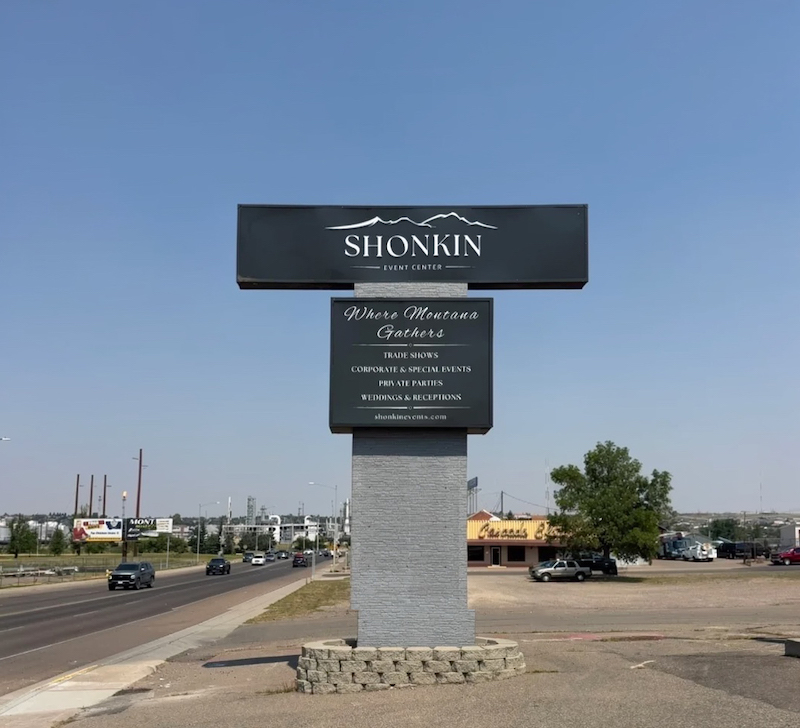
Today, the building operates as the Shonkin Event Center, a flexible community venue with capacity for up to 300 guests and layouts ranging from approximately 3,500 to 32,500 square feet. It hosts trade shows, weddings, corporate functions and major regional events, including Legends Best of the West exhibitions during Western Art Week.
From a small $500 family furniture business to a pioneering self-service warehouse, and from an antique mall and recreation center to today’s Shonkin Event Center, the building at 901 9th St. N. has continually reinvented itself.
Its history is more than the story of a building. It is a reflection of Great Falls itself—an enduring part of the community that has adapted, changed and continued serving new generations for more than seven decades.
Research by The Cascade County Historical Society: The History Museum