


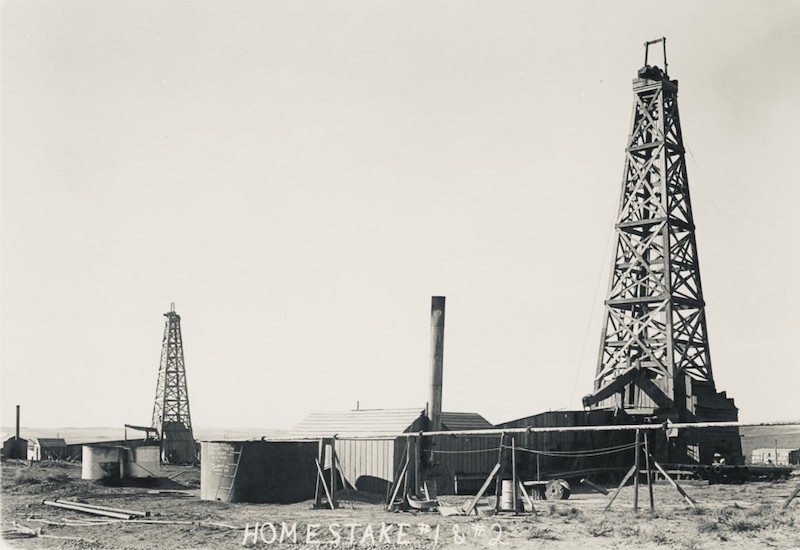
The Cat Creek Oil Field is located twenty miles west of Winnett, Montana. Local legend had it that a cowboy roped a mountain lion in a creek flowing into the Musselshell River, giving rise to the name, Cat Creek.
In late 1919, the Denver based Frantz Corporation began oil exploration at Cat Creek. After they struck “black gold” at a depth of 1,015 feet, (considered “the highest grade of oil known to any oil fields), the industry began to boom in Montana. The venture was remarkably profitable for Frantz Oil and its success drew oil companies from around the region to the Cat Creek fields.
The area surrounding Cat Creek is very isolated; so initially supplies were hauled from Winnett, which was connected by rail, and became the supply depot for mining activities. John
S. “Curley” Meek, one of the first drillers in the Cat Creek area, stated that “there was no place to store the oil, so it was dammed up in a coulee and given away to ranchers and farmers to use in their cars. It was of such a high quality that tractors and Ford Model T automobiles could run on the oil directly from the ground.
Storage tanks were quickly constructed by the Frantz Corporation who also constructed a pipeline to carry the oil to Winnett where it was shipped by rail to refineries in Wyoming.
In April 1921, thirty producing wells owned by six different companies, were at work. In a “raw, roaring oil camp,” as many as 300 men lived in the area in tar paper shacks for families, with company bunkhouses for single men, a company cook house and a recreation hall. In the town that sprang up, only a post office, church, school and cemetery provided services. The post office, established in 1922, remained active until 1996.
The peak of production was recorded in 1922, with eleven wells drilling three million barrels of oil. With the continued development of the Cat Creek oil fields and the resulting increase in the area’s population, the Montana Legislature voted on November 24, 1924, to form a new county, sectioned off from eastern Fergus County and western Garfield County. Petroleum County officially became Montana’s 56th and final county in February 1925. Winnett, with a population in 1923 of 2,000, became the county seat.
As prosperity continued, a four-inch oil pipeline was built to the railroad station of neighboring Winnett, where more than 150 oil pumps operated during Cat Creek’s peak. Although
the boom was over by 1975, Cat Creek retains an impressive production history of more than twenty-three million barrels of oil.
As of the 2020 census, Petroleum County had a population of 496 and is the least populated county in Montana. It is also one of the least populous counties in the entire United States.