


By Billie J Olson
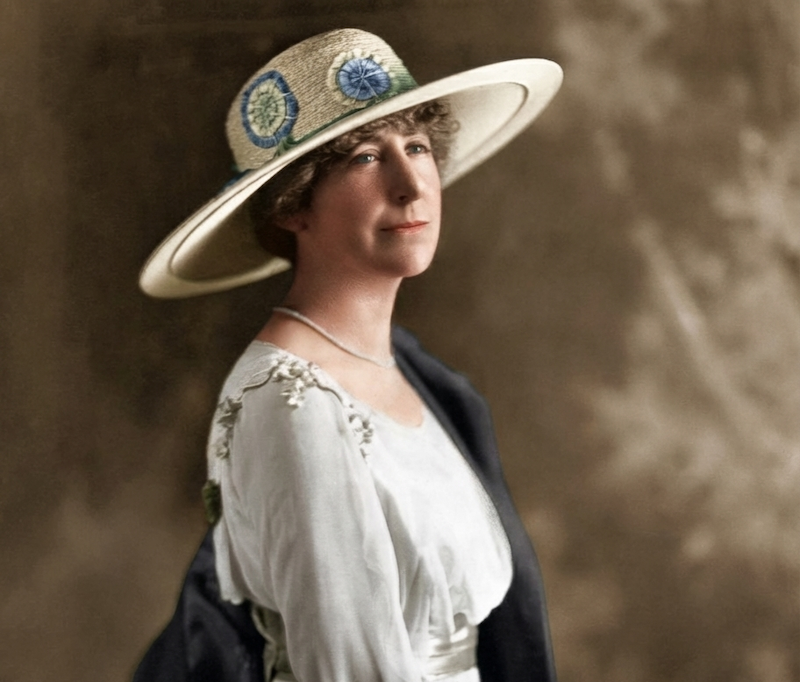
Jeannette Rankin’s upbringing on a prosperous ranch in the Montana Territory instilled a strong work ethic and an awareness of social injustice that shaped her historic career as the first woman elected to the U.S. Congress. Her early life on the frontier, where men and women often worked side-by- side out of necessity, provided a powerful lesson in “practical equality”—an observation that contrasted sharply with the lack of political power afforded to women at the time and became a driving force behind her lifelong commitment to women’s suffrage and social reform.
Early Life and the Making of an Activist
Born on June 11, 1880, Jeannette Rankin was the eldest of seven children, growing up on the family’s extensive Grant Creek Ranch near Missoula, Montana Territory. Her father, John Rankin, a successful rancher, builder, and real estate businessman, and her mother, Olive Pickering, a schoolteacher who had moved from New Hampshire, provided a stable, prosperous environment that offered young Jeannette opportunities unavailable to many in the fledgling territory.
Ranch life was demanding. Rankin was expected to contribute significantly, undertaking everything from household tasks and farm work to maintaining ranch machinery and even single- handedly building a wooden sidewalk for one of her father’s properties so it could be rented out. Her father treated her as a protégé, exposing her to responsibilities and expectations often reserved for sons at the time.
These experiences fostered a unique understanding of gender roles. She later observed that the practical equality she witnessed, where women labored as equals with men out of frontier necessity, stood in stark contradiction to the fact that those same women lacked the fundamental right to vote. This early realization was a pivotal influence, shaping her future as a suffragist.
Education followed local schooling and high school graduation in 1898. Rankin earned a Bachelor of Science degree in biology from the University of Montana in 1902. A brief post- graduation period as a teacher and an apprentice seamstress led her to a pivotal moment. After her father’s death in 1904, a trip to Boston to visit her brother exposed her to the scale of urban poverty, sparking her interest in social work. Volunteer work at the Telegraph Hill settlement house in San Francisco followed this realization, serving as the critical experience that defined her calling. This calling led her to the New York School of Philanthropy (now part of Columbia University School of Social Work), from which she graduated in 1909, formalizing the foundation for her life as an advocate and politician.
Pioneering Career and the Weight of Conviction
Jeannette Rankin is best known as the first woman elected to the U.S. Congress and, more controversially, as the only member of Congress to vote against U.S. entry into both World War I and World War II. Her career, spanning six decades of activism, was defined by an unwavering pacifism that generated immense controversy and twice effectively ended her congressional bids.
During her first term in 1917, she was one of just fifty House members to vote against declaring war on Germany, a decision that drew widespread criticism and contributed to her initial defeat for re-election in 1918.
Her second anti-war vote became the defining moment of her legacy. On December 8, 1941, the day after the attack on Pearl Harbor, Rankin cast the single dissenting vote against the U.S. declaration of war against Japan, stating, “As a woman, I can’t go to war, and I refuse to send anyone else.”
This act of profound conviction was met with overwhelming condemnation. She was denounced by the press, labeled a traitor by some constituents, and her political career in Congress was over—for a time. Yet, her commitment to pacifism never wavered.
After leaving Congress the second time, she spent decades as a lobbyist, lecturer, and peace activist, continuing to fight for social welfare and international disarmament. Her legacy endures not just as a pioneer for women in politics, but as a fearless independent thinker who prioritized the weight of her conscience over political expediency.
Rankin died in May 1973, shortly after a third congressional campaign to protest the Vietnam War, a conflict she had long opposed. She is remembered as “The Original Dove in Congress,” a title that perfectly captures the strength of the Montana ranch girl who forever changed the face of American politics and the definition of a principled conviction.