
By Suzanne Waring
Great Falls is the home of one of Montana’s most famous pioneers. William Wesley Van Orsdel, or more fondly known as Brother Van, came to Montana on the Far West steamboat in 1872. He told the steamboat captain that he was going to Montana “to sing, to preach, and to encourage people to be good.” He loved all the people he met, including the homesteaders, American Indians, freighters, cowboys, soldiers, gamblers, miners; and all of the people, in return, loved him for his caring attitude,charismatic personality, and booming voice that often broke into song.
There were so few Methodist preachers to cover the vast state that he became a circuit rider which he continued to do under various job titles for the next forty-five years. His experiences in his native state of Pennsylvania taught him that the only way to reach people was to go to their communities and into their homes.
Brother Van inspired the building of a hundred churches, seven hospitals, a children’s home, and a college. When others said, “How could we possibly do such a thing?” Brother Van responded with, “How could we possibly NOT DO such a thing?… we must not let this opportunity for service pass us by.”
Over the years these facilities have grown and some have changed their names in an effort to respond to the welfare of the ever-changing lives of those residing in the state. Brother Van’s legacy lives on with Benefis Healthcare, Rocky Mountain College, Bozeman Health, Billings Clinic, Northern Montana Hospital, Intermountain Children’s Home in Helena, and the churches that serve communities across Montana. He is remembered as the one who dedicated the Montana Capitol and many of the courthouses, including the Cascade County Courthouse in 1903 and who served on infinite statewide committees, especially those that benefited children.
He was so well known that he didn’t need an appointment to see any of the governors. He could walk right into their offices. Governors often invited him to lunch so they could be seen with him on the street because he was more popular than they were. When Brother Van died in 1919, the flag at the Capitol was lowered to half-staff, which was quite extraordinary because the flag was lowered at that time for only governmental officials or military personnel.
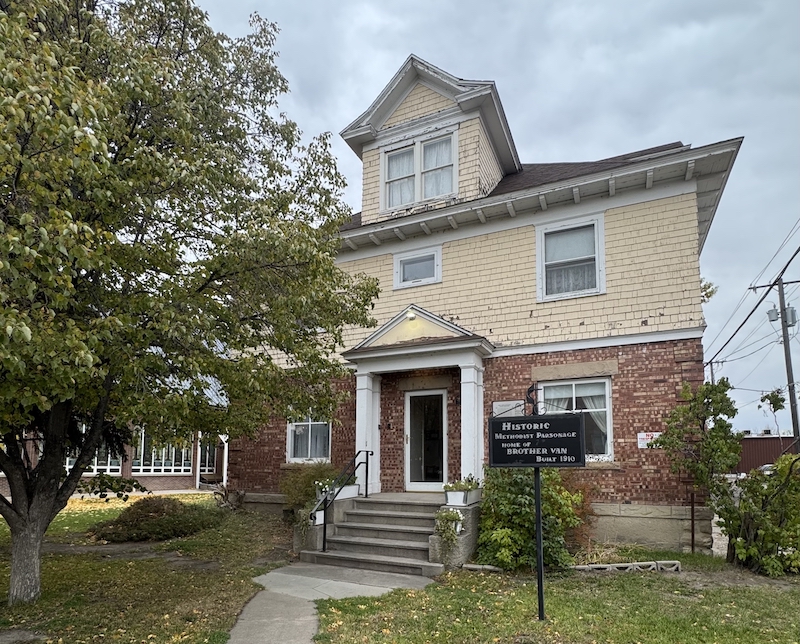
Because the young lady he was engaged to marry died of tuberculosis, Brother Van never married. He often had a room in a boarding house somewhere on his circuit. In 1892 he was sent to Great Falls to be in charge of the Methodist Churches in North and Central Montana, a job that kept him on the road. When a new parsonage was built in Great Falls in 1910, the first resident pastor invited Brother Van to live with the family. He took his own furniture to furnish his room. It was the only home that he really knew in all of the years that he had lived in Montana. Today that home is the Brother Van House Museum. The museum is operated by the Brother Van Experience Committee of the First United Methodist Church. For twenty- five years the committee has slowly restored the house in the motif of 1910 when it was built.
During docent-led tours of the museum, stories are told of Brother Van’s adventures that will raise the hair on your neck, bring a tear to your eye, and make you chuckle. As they guide you through this century-old house, giving you an idea of how many of the private older homes on the Northside of Great Falls were built, you will learn about the settlement of Montana and the role that the “Best Loved Man in Montana” played in making this the wonderful state that it is. Admission to the Brother Van House Museum is free.
Call 406-453-3114 to make an appointment for a private tour of the home or to learn when the home at 113 Sixth Street North is routinely open for tours.